
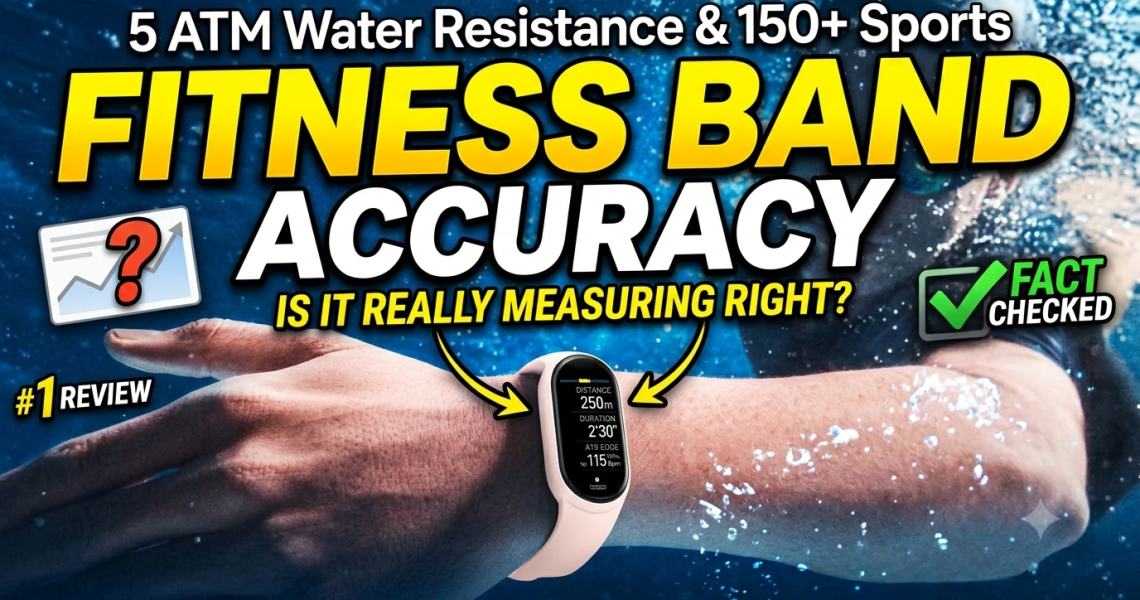
Fitness Band Accuracy: What You Really Need to Know
July 29, 2026Fitness Band Accuracy: What You Really Need to Know Before Trusting Your Tracker
Fitness band accuracy is one of the biggest questions people ask before buying or relying on a wearable fitness tracker. Whether you’re tracking steps, heart rate, calories burned, sleep, or workouts, it’s natural to wonder: How accurate is a fitness band, really? The answer isn’t as simple as yes or no. Accuracy depends on the feature you’re measuring, the device itself, how you wear it, and what you’re doing at the time.
In this guide, we’ll look at how accurate fitness bands are for everyday health and fitness tracking, where they perform well, where they can be misleading, and how you can get more reliable results from your device. We’ll also explain the difference between fitness bands and medical-grade equipment so you know when to trust your wearable and when to seek a professional measurement.
What Is Fitness Band Accuracy?
Fitness band accuracy refers to how closely a wearable device’s measurements match a reliable reference or real-world value.
Modern fitness bands use a combination of sensors and software algorithms to estimate different metrics, including:
- Daily steps
- Heart rate
- Calories burned
- Distance traveled
- Sleep duration
- Sleep stages
- Exercise intensity
- Blood oxygen saturation
- Stress levels
- Active minutes
However, not every measurement is equally accurate.
A fitness band may be very good at counting steps during a normal walk but less reliable when you’re pushing a shopping cart. Similarly, a wrist-based heart-rate sensor may perform well during steady exercise but struggle during high-intensity workouts or activities involving rapid wrist movement.
The most important thing to remember is that fitness trackers are generally designed for wellness and fitness insights, not to replace professional medical equipment.
How Accurate Are Fitness Bands?
The short answer is: it depends on what you’re measuring.
Research has found that wearable devices can provide useful estimates, but accuracy varies significantly between devices, users, activities, and measurement types.
For example, a systematic review published in the Journal of Medical Internet Research found that consumer wearable devices can provide reasonably accurate heart-rate measurements under many conditions, but accuracy can vary depending on exercise intensity and device characteristics.
Step counting can also be reasonably accurate during regular walking, but errors may increase during activities that involve less arm movement.
Here’s a general overview:
| Fitness Metric | Typical Reliability | What Can Affect Accuracy |
|---|---|---|
| Step counting | Generally good | Arm movement, walking speed, device placement |
| Resting heart rate | Generally good | Fit, skin contact, movement |
| Exercise heart rate | Moderate to good | Workout type, motion, sweat, fit |
| Distance | Moderate | GPS availability, stride estimation |
| Calories burned | Less precise | Age, weight, fitness level, exercise type |
| Sleep duration | Moderate | Movement, device algorithms |
| Sleep stages | More variable | Individual sleep patterns and algorithms |
| SpO₂ | Useful for trends | Fit, movement, skin contact, circulation |
These categories should be viewed as general guidance rather than guaranteed accuracy percentages for every fitness band.
Fitness Band Accuracy for Step Counting
Step tracking is one of the most popular features of fitness bands, and it’s also one of the metrics that can be relatively reliable under normal conditions.
Most fitness trackers use an accelerometer to detect movement patterns associated with walking and running. The device’s software then interprets those movements as steps.
When Step Counters Work Well
Your fitness band is usually more reliable when:
- You’re walking at a normal pace.
- The band is worn securely on your wrist.
- Your arm moves naturally while walking.
- You’re walking on a relatively even surface.
- The device has been configured correctly.
When Step Counting Can Be Inaccurate
Your step count may be affected when:
- You push a shopping trolley.
- You hold onto a treadmill.
- You carry something heavy.
- You move your hands repeatedly while sitting.
- You perform repetitive arm movements.
- You ride in a vehicle over a bumpy road.
For example, if you walk for 30 minutes while pushing a shopping cart, your legs are moving but your wrist movement may be reduced. Depending on the device’s algorithms, some steps may not be detected.
Tip: Use your daily step count to monitor trends rather than treating the number as an exact scientific measurement.
How Accurate Are Fitness Bands for Heart Rate?
Heart-rate monitoring has become a standard feature in modern fitness bands.
Most wrist-based devices use photoplethysmography (PPG). The sensor shines light into the skin and measures changes in blood volume associated with your heartbeat.
This technology can be useful for monitoring:
- Resting heart rate
- Heart-rate trends
- Workout intensity
- Recovery patterns
- Heart-rate zones
Resting Heart Rate Accuracy
Fitness bands can often provide useful estimates of resting heart rate, especially when the wearer is still and the device has good skin contact.
For many users, the most valuable information isn’t one isolated number. It’s the long-term trend.
If your resting heart rate gradually changes over weeks or months, that may provide useful insight into changes in fitness, recovery, stress, or lifestyle.
Exercise Heart Rate Accuracy
Accuracy during exercise can be more complicated.
Wrist-based heart-rate tracking may become less reliable during:
- Weightlifting
- Boxing
- HIIT workouts
- Cycling with heavy vibration
- Exercises involving rapid wrist movement
- Activities with poor sensor contact
For serious athletes who need highly precise heart-rate data, a compatible chest-strap monitor may be preferable.
How to Improve Heart Rate Accuracy
To get better readings:
- Wear the fitness band snugly.
- Position it slightly above the wrist bone.
- Keep the sensor clean.
- Avoid wearing it too loosely.
- Follow the manufacturer’s recommended placement.
- Give the device time to establish a stable reading.
A band that is too loose can allow movement between the sensor and your skin, potentially reducing measurement quality.
Are Fitness Bands Accurate for Calories Burned?
This is where you should be particularly cautious.
Calories burned are estimated, not directly measured by most consumer fitness bands.
Your device may calculate calorie expenditure using information such as:
- Age
- Sex
- Height
- Weight
- Heart rate
- Movement
- Workout duration
- Activity type
The problem is that calorie expenditure varies significantly from person to person.
Two people can complete the same workout and burn different amounts of energy.
Why Calorie Estimates Can Be Wrong
A fitness band doesn’t directly measure every physiological process involved in energy expenditure. Instead, algorithms estimate your calorie burn based on available data.
Therefore, don’t assume that a fitness band saying you burned 500 calories means the actual number was exactly 500.
A better approach is to use calorie estimates as a general reference point.
If you’re trying to lose weight, your overall results should be evaluated using multiple factors, such as:
- Body-weight trends
- Waist measurements
- Nutrition
- Physical activity
- Strength and fitness improvements
- Overall consistency
Avoid relying entirely on wearable calorie estimates to determine how much food you should eat.
How Accurate Are Fitness Bands for Sleep Tracking?
Sleep tracking has become increasingly popular, but it’s important to understand its limitations.
Fitness bands typically estimate sleep based on:
- Movement
- Heart rate
- Heart-rate variability
- Other sensor data
Some devices attempt to identify different sleep stages, such as:
- Light sleep
- Deep sleep
- REM sleep
- Awake periods
Sleep Duration vs. Sleep Stages
A fitness band may be more useful for estimating when you slept and how long you were in bed than for precisely identifying every sleep stage.
For example, a device might detect that you were lying still and classify that period as sleep. However, being motionless doesn’t always mean you’re actually asleep.
This is why sleep-stage data should be treated as an estimate rather than a clinical diagnosis.
The Best Way to Use Sleep Tracking
Look for long-term patterns.
Ask questions such as:
- Am I sleeping more consistently?
- Is my bedtime changing?
- Am I waking frequently?
- Does my sleep duration improve when I exercise regularly?
- Do I feel rested after the amount of sleep my tracker reports?
Your personal experience and sleep quality matter alongside the data from your wearable.
Are Fitness Bands Accurate for SpO₂?
Some fitness bands include SpO₂ sensors that estimate blood oxygen saturation.
While this feature can be useful for general wellness tracking, consumer wearable readings should not automatically be treated as equivalent to measurements from medical-grade devices.
Readings may be affected by:
- Device placement
- Movement
- Sensor contact
- Skin temperature
- Circulation
- Device design
If you’re concerned about your oxygen levels or have symptoms that require medical attention, use appropriate medical equipment and consult a healthcare professional rather than relying solely on a fitness band.
Why Does My Fitness Band Show the Wrong Data?
There are several reasons why your fitness tracker may produce unexpected results.
1. Incorrect Device Placement
A band that is too loose may move around during the day.
2. Poor Sensor Contact
Sweat, dirt, hair, or movement can affect sensor performance.
3. Wrong Personal Information
Check whether your profile contains the correct:
- Age
- Height
- Weight
- Sex
These details may influence calculations such as calorie expenditure and distance.
4. Activity Type
Some activities are simply harder for wrist-based sensors to interpret.
5. Software Algorithms
Fitness bands use algorithms to interpret raw sensor data. Different brands and models may produce different estimates.
6. Battery or Sensor Problems
A damaged or malfunctioning sensor can also cause unusual readings.
Fitness Tracker Accuracy vs. Medical Devices
One of the most important distinctions is the difference between a consumer fitness wearable and a medical device.
Fitness bands are primarily designed to help people understand activity and wellness trends.
Medical devices, on the other hand, are designed and validated for specific clinical applications and may undergo different regulatory requirements.
Fitness Bands Are Great For:
- Tracking daily activity
- Monitoring exercise habits
- Observing heart-rate trends
- Encouraging movement
- Monitoring general wellness
- Identifying lifestyle patterns
Fitness Bands Shouldn’t Replace:
- Professional medical diagnosis
- Clinical heart monitoring
- Medical-grade blood pressure measurement
- Professional sleep studies
- Medical evaluation of symptoms
If your fitness band gives you an unusual reading, don’t immediately panic. Consider repeating the measurement under suitable conditions and speak with a healthcare professional if you have concerns.
How to Make Your Fitness Band More Accurate
You can improve the quality of your fitness data by following a few simple steps.
Step 1: Wear It Correctly
Follow the manufacturer’s instructions for placement.
Step 2: Keep It Clean
Clean the sensor and the area of your skin that touches the device.
Step 3: Update the Firmware
Manufacturers may release updates that improve algorithms and device performance.
Step 4: Enter Accurate Personal Information
Make sure your height, weight, age, and other relevant details are correct.
Step 5: Select the Correct Workout
If your device supports workout modes, choose the activity that best matches what you’re doing.
Step 6: Compare Trends
Don’t obsess over individual readings. Look at changes over days, weeks, and months.
Step 7: Compare With Reliable Measurements
If accuracy is critical, occasionally compare your fitness band’s readings with an appropriate reference device.
Should You Trust Your Fitness Band?
The best answer is: trust it for trends, but understand its limitations.
A fitness band can be extremely useful for motivation and personal awareness.
For example, you might discover that:
- You average fewer steps on workdays.
- Your resting heart rate improves after regular exercise.
- You sleep better when you maintain a consistent bedtime.
- Your activity level drops during busy weeks.
These insights can help you make better lifestyle decisions.
However, you shouldn’t treat every number as perfectly precise.
Think of your fitness band as a personal dashboard, not a laboratory.
Fitness Band Accuracy: What the Research Says
Research into wearable technology has generally found that accuracy varies substantially depending on the metric being measured.
Studies have often found that consumer wearables can provide useful heart-rate measurements, particularly during rest and some steady-state activities. However, performance can vary during exercise and across different devices.
Step counting can also be reasonably accurate during normal walking, while energy expenditure and sleep-stage estimation tend to have greater uncertainty.
This leads to an important takeaway:
The usefulness of a fitness band doesn’t depend on every measurement being perfect.
The real value often comes from consistent data collected over time.
7 Common Fitness Band Accuracy Mistakes
Avoid these common mistakes when interpreting your fitness data:
- Treating calorie estimates as exact numbers
- Comparing readings from different brands as if they are identical
- Wearing the band too loosely
- Ignoring the effect of exercise type on heart-rate accuracy
- Assuming sleep-stage results are medically precise
- Using a wearable as a substitute for professional medical advice
- Focusing on one reading instead of long-term trends
The goal is to use technology intelligently rather than expecting it to be perfect.
People Also Ask: Fitness Band Accuracy
How accurate are fitness bands?
Fitness bands can be reasonably accurate for some measurements, particularly step counting during normal walking and heart-rate tracking at rest. Accuracy varies depending on the device, activity, fit, and measurement type.
Are fitness bands accurate for heart rate?
Many fitness bands provide useful heart-rate estimates, especially during rest and steady activities. Accuracy can decrease during intense or highly dynamic exercise. A chest strap may be more suitable when highly precise exercise heart-rate data is required.
Can I trust my fitness band’s calorie count?
Calorie counts should be considered estimates rather than exact measurements. They can be useful for observing general trends, but they shouldn’t be treated as a precise calculation of energy expenditure.
Are fitness bands accurate for sleep tracking?
Fitness bands can provide useful estimates of sleep duration and general sleep patterns. However, sleep-stage measurements such as REM and deep sleep are estimates and may not be as accurate as clinical sleep testing.
Which fitness tracker is the most accurate?
There is no single fitness tracker that is guaranteed to be the most accurate for every metric. Accuracy varies by device, sensor technology, software, activity, and user. The best choice depends on whether your priority is steps, heart rate, GPS, sleep, or another feature.
Can a fitness band detect health problems?
Some wearables may identify unusual patterns or provide health-related notifications, but they are not a substitute for professional diagnosis. If you have concerning symptoms or receive an unusual reading, consult an appropriate healthcare professional.
Why is my fitness band’s step count different from my phone?
Your phone and fitness band use different sensors and algorithms. Your phone may not be with you for every activity, while your wrist may move in ways that cause the band to count or miss certain movements.
The Bottom Line on Fitness Band Accuracy
Fitness bands have come a long way, and they can be incredibly useful tools for people who want to become more active, understand their habits, and monitor health and fitness trends.
But no wearable is perfect.
The accuracy of a fitness band depends on:
- The quality of its sensors
- The algorithms used by the manufacturer
- How you wear the device
- The type of activity you’re performing
- Your individual characteristics
- The specific metric you’re measuring
For the best results, focus on patterns rather than perfection.
Use your fitness band to stay active, monitor progress, set goals, and understand your lifestyle. If you need medical-grade measurements or have concerns about your health, use appropriate clinical equipment and seek professional advice.
Ready to Get More From Your Fitness Tracker?
Don’t just wear your fitness band. Use the data intelligently.
Start by checking your device settings, wearing it correctly, and tracking your progress over several weeks. Share this guide with friends and family who use fitness trackers, and let us know in the comments which fitness band you use and how accurate you’ve found its readings.