
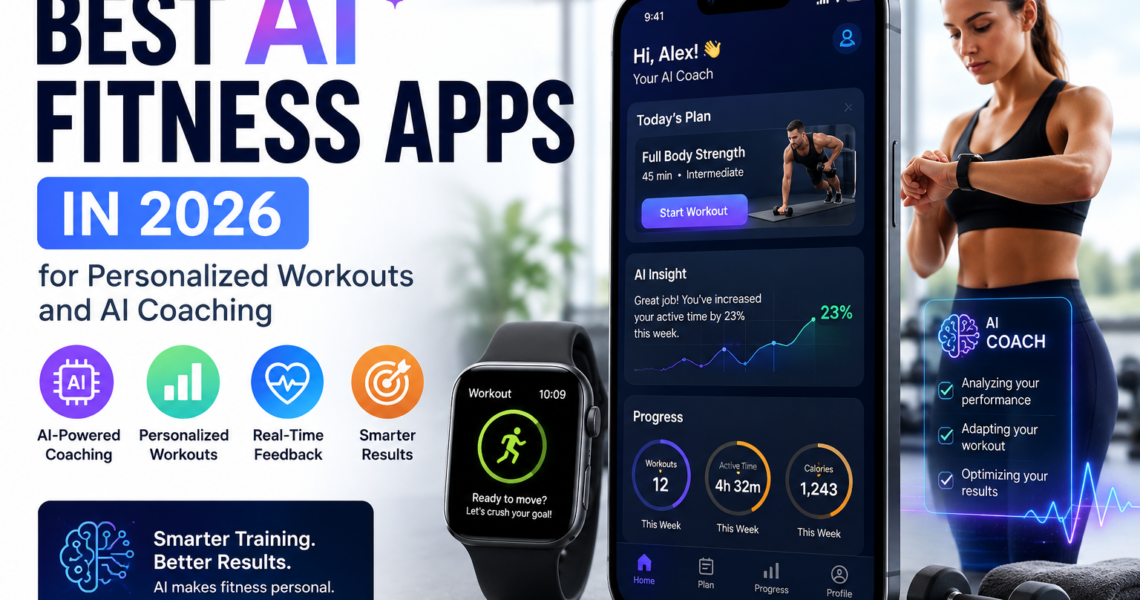
Best AI Fitness Apps in 2026
June 15, 2015Best AI Fitness Apps in 2026: Top AI Workout Apps for Smarter Training
Finding the right workout plan can be harder than doing the workout itself. You need to choose exercises, decide how many sets and reps to perform, track your progress, manage recovery, and keep your routine aligned with your goals. That is where the best AI fitness apps in 2026 are changing the way people train.
Modern AI fitness apps can create personalized workouts, adjust training based on your history, analyze performance, provide running plans, track exercise form, and even use wearable data to deliver more relevant recommendations. At the same time, not every app marketed as “AI-powered” offers the same level of personalization.
In this guide, we’ll compare some of the leading AI fitness apps in 2026, explain what makes each one different, discuss who should use them, and show you how to choose the right AI workout app for your goals.
Quick Comparison: Best AI Fitness Apps in 2026
| AI Fitness App | Best For | Key AI Feature | Best Training Type |
|---|---|---|---|
| Fitbod | Strength & muscle building | Adaptive workout generation | Gym & strength |
| Freeletics | Home & HIIT workouts | AI Coach | Bodyweight & HIIT |
| FitnessAI | Personalized gym workouts | AI-generated sets and reps | Strength training |
| Peloton IQ | Connected fitness | Workout generation, form feedback & recommendations | Strength & cardio |
| Runna | Running | Personalized training plans | 5K to marathon |
| Caliber | Strength tracking | Personalized analytics and training tools | Gym & strength |
| Ray | AI personal coaching | Computer-vision form and real-time coaching | Home & gym |
| Ladder | Structured strength programs | Adaptive coaching experience | Strength training |
Editor’s note: AI capabilities, subscriptions, integrations, and supported devices can change frequently. Check each app’s current offering before subscribing.
What Are AI Fitness Apps?
AI fitness apps use artificial intelligence, machine learning, algorithms, computer vision, or data-driven personalization to make workout and fitness recommendations more relevant to an individual.
Traditional fitness apps may simply provide a library of exercises or pre-written workout programs. AI-powered fitness apps attempt to use information such as:
- Fitness level
- Workout history
- Training goals
- Available equipment
- Exercise preferences
- Workout duration
- Training frequency
- Performance data
- Recovery information
- Wearable-device data
The result can be a more flexible training experience instead of following exactly the same routine every week.
This distinction is becoming increasingly important in 2026. The American College of Sports Medicine’s 2026 Worldwide Fitness Trends survey ranked wearable technology as the number-one fitness trend, highlighting the growing importance of fitness trackers, smartwatches, heart-rate monitors, and other connected devices.
How Do AI Fitness Apps Work?
Although the technology varies between apps, the basic process is relatively straightforward.
1. You enter your goals
You may tell the app that you want to:
- Build muscle
- Lose weight
- Improve endurance
- Increase strength
- Run a faster 5K
- Prepare for a marathon
- Improve mobility
- Exercise at home
2. The app learns about you
Depending on the platform, it may collect information about your training history, fitness level, available equipment, schedule, and preferences.
3. AI or adaptive algorithms generate recommendations
The app can then create or modify workouts based on the information available to it.
4. You provide feedback
Some apps ask how difficult a workout felt, whether you were sore, or whether you completed the session.
5. Future workouts can change
The biggest advantage of adaptive fitness technology is that your next workout doesn’t necessarily have to look exactly like the previous one.
1. Fitbod: Best AI Fitness App for Strength Training
Best for: Muscle building, strength training, gym users and people who want highly personalized workouts.
Fitbod is one of the strongest choices for people whose primary objective is strength and muscle development.
The platform uses a personalized algorithm that considers factors such as training history, fitness goals, muscle recovery and available equipment when generating workouts.
Fitbod’s current membership page lists a monthly plan and an annual plan, although pricing can vary by market and promotion.
Why Fitbod stands out
- Personalized strength workouts
- Exercise substitutions
- Equipment-aware programming
- Training-history analysis
- Progressive overload focus
- Muscle recovery estimates
- Workout tracking
- Apple Watch and Wear OS support
Fitbod says its system is built around adaptive programming rather than simply selecting a random collection of exercises.
Best for
Choose Fitbod if you regularly train in a gym and want the app to handle much of the programming work.
Our verdict: ★★★★★
Best AI fitness app for: Strength and hypertrophy.
2. Freeletics: Best AI Fitness App for Home Workouts and HIIT
Best for: Bodyweight training, HIIT, home workouts and people with changing schedules.
Freeletics takes a different approach from gym-focused apps. Its AI Coach creates personalized training based on your goals, feedback and progress. The platform supports bodyweight workouts as well as optional equipment.
The company says more than 60 million people have used Freeletics worldwide and reports hundreds of millions of completed training sessions.
Key features
- AI Coach
- HIIT workouts
- Bodyweight training
- Strength workouts
- Cardio
- Running
- Flexible workout duration
- Home-friendly sessions
- Personalized training plans
Freeletics is particularly useful if you don’t want to depend on a fully equipped gym. Its workouts can be adapted around factors such as available time and training environment.
Best for
Freeletics is a strong option for travelers, beginners, busy professionals and anyone who prefers training at home.
Our verdict: ★★★★★
Best AI fitness app for: Home and bodyweight training.
3. FitnessAI: Best for AI-Generated Gym Workouts
Best for: People who want personalized sets, reps and gym programming.
FitnessAI focuses heavily on personalized strength workouts.
According to the company, the app has been downloaded by more than 5 million people and provides AI-powered workouts that evolve as users become stronger.
Key features
- AI-generated workouts
- Personalized sets and reps
- Workout progression
- Strength tracking
- Exercise recommendations
- Personalized training structure
The main attraction is convenience. Instead of deciding exactly what to train every time you enter the gym, the app can help create a structured session around your goals.
Best for
FitnessAI makes sense for gym users who want automated programming without paying for a traditional personal trainer.
Our verdict: ★★★★☆
Best AI fitness app for: Automated gym programming.
4. Peloton IQ: Best AI Fitness Experience for Connected Fitness
Best for: Peloton users who want AI-powered workout planning, performance insights and form feedback.
Peloton has moved beyond instructor-led classes with Peloton IQ, its AI-powered personalization system.
The platform offers features including:
- Workout Generator
- Rep Tracking
- Form Feedback
- Suggested Weights
- Self-Paced Strength
- Hands-Free Control
- Performance estimates
- Workout insights
- Personalized recommendations
Peloton says its movement-tracking camera can count repetitions and provide real-time form feedback for supported movements.
The company also reported in February 2026 that Peloton IQ had been released to all members, with nearly half of active members engaging with personalized insights and recommendations by the end of that quarter.
Best for
Peloton IQ is especially attractive if you’re already invested in the Peloton ecosystem and want AI to complement instructor-led fitness.
Our verdict: ★★★★☆
Best AI fitness app for: Connected fitness and AI-assisted strength training.
5. Runna: Best AI-Style Personalized App for Runners
Best for: 5K, 10K, half-marathon and marathon training.
Not every intelligent fitness platform needs to focus on gym workouts.
Runna specializes in personalized running plans. It creates structured programs around the runner’s goals, ability and schedule.
Its training plans can cover distances ranging from beginner 5K programs to marathon and ultra-distance preparation. Runna also integrates with devices such as Fitbit for workout tracking and plan synchronization.
The platform has also introduced personalized Workout Briefings that analyze previous performance and provide guidance before scheduled sessions.
Key features
- Personalized running plans
- 5K training
- 10K training
- Half-marathon training
- Marathon training
- Strength training for runners
- Workout guidance
- Wearable integrations
- Performance tracking
Best for
If running is your main sport, a specialized running platform can be more useful than a general AI gym app.
Our verdict: ★★★★☆
Best AI fitness app for: Running and race preparation.
6. Caliber: Best for Strength Tracking and Fitness Analytics
Best for: Lifters who want detailed workout tracking and strength analytics.
Caliber is more focused on science-based strength training, tracking and coaching than flashy AI features.
The app offers more than 100 strength and mobility plans, 700+ exercises, progress analytics, strength scores and wearable integrations.
Key features
- Strength programs
- Exercise tracking
- Progressive overload
- Strength analytics
- Exercise substitutions
- Workout history
- Nutrition targets
- Wearable integration
- Coaching options
Best for
Caliber is worth considering if you care more about structured strength training and measurable progress than having an AI chatbot generate every workout.
Our verdict: ★★★★☆
Best for: Data-focused strength training.
7. Ray: Best for Real-Time AI Workout Coaching
Best for: Users who want an AI coach that can watch movement and provide feedback.
One of the more interesting AI fitness developments in 2026 is the move toward computer vision.
Ray uses an iPhone camera to monitor exercises, count repetitions and provide coaching. A recent hands-on review from Tom’s Guide described the app as capable of adapting workouts according to factors such as fatigue, soreness and available time.
Potential advantages
- AI coaching
- Computer-vision exercise tracking
- Rep counting
- Real-time feedback
- Workout adjustments
- Audio coaching
- Apple Health integration
Best for
Ray is particularly interesting if you want something closer to an interactive digital personal trainer rather than a simple workout database.
Our verdict: ★★★★☆
Best for: Real-time AI coaching.
8. Ladder: Best for Structured Strength Programs
Best for: People who prefer a guided strength-training system rather than completely automated workouts.
Ladder belongs in the broader conversation around personalized digital strength coaching. Its appeal is the structured-program approach, where users can follow organized training rather than repeatedly asking an AI to invent a new workout.
Best for
- Strength training
- Progressive programs
- Gym users
- People who need accountability
- Users who prefer structure over randomness
Our verdict: ★★★★☆
Best for: Structured digital strength coaching.
Best AI Fitness Apps by Goal
Choosing the best app becomes much easier when you start with your goal.
Best AI Fitness App for Muscle Building
Fitbod is one of the strongest options because its programming focuses heavily on strength, equipment availability, training history and recovery.
Best AI Fitness App for Beginners
Freeletics is a strong choice because it offers structured workouts and can be used without a traditional gym setup.
Best AI Fitness App for Home Workouts
Freeletics is particularly suitable for bodyweight and limited-equipment training.
Best AI Fitness App for Runners
Runna is the obvious specialist choice for structured running plans.
Best AI Fitness App for Gym Training
Fitbod or FitnessAI are worth considering if your primary goal is gym-based strength training.
Best AI Fitness App for Form Feedback
Peloton IQ and camera-based systems such as Ray are among the more interesting choices for movement and form analysis.
Best AI Fitness App for Data Tracking
Caliber is a strong option for users who want detailed strength analytics and workout history.
What Makes an AI Fitness App Actually Good?
“AI-powered” is now a common marketing term. But AI alone doesn’t make an app useful.
Before subscribing, look for these characteristics.
1. Genuine Personalization
A good app should do more than ask for your age and fitness goal before giving everyone essentially the same routine.
Look for personalization based on:
- Previous workouts
- Performance
- Available equipment
- Training frequency
- Workout duration
- Exercise preferences
- Recovery
2. Adaptability
Your training plan should be capable of changing.
For example:
You planned a 60-minute workout but only have 25 minutes.
A useful adaptive system should be able to modify the session instead of simply telling you to complete the original 60-minute routine.
3. Good Exercise Selection
AI-generated workouts are only useful when the underlying exercise library and programming logic are reliable.
The app should provide clear instructions and sensible exercise substitutions.
4. Progress Tracking
Look for features such as:
- Weight progression
- Repetition history
- Workout frequency
- Personal records
- Running pace
- Distance
- Training volume
5. Wearable Integration
Wearable integration is becoming increasingly important.
ACSM ranked wearable technology as the #1 fitness trend for 2026, showing how central connected health data has become to modern fitness.
6. Human Expertise
AI shouldn’t automatically replace professional expertise.
The strongest fitness platforms combine technology with exercise science, qualified coaches, established programming principles and appropriate safety guidance.
AI Fitness Apps vs. Personal Trainers
One of the biggest questions is whether an AI fitness app can replace a personal trainer.
The short answer is: not completely.
AI fitness apps can offer
- Lower cost
- 24/7 availability
- Personalized programming
- Workout tracking
- Exercise libraries
- Automated adjustments
- Progress analytics
- Convenient home workouts
Human trainers can offer
- Real-time human judgment
- Detailed coaching
- Personalized motivation
- Physical observation
- Context that an algorithm may miss
- Modifications for complex individual circumstances
AI fitness apps are best viewed as digital training tools, not universal replacements for qualified professionals.
Are AI Fitness Apps Safe?
They can be useful, but users should not blindly follow every recommendation.
An AI system does not have the same judgment as a qualified healthcare or fitness professional.
Be particularly careful if you:
- Have an existing injury
- Experience unexplained pain
- Have a medical condition
- Are returning to exercise after a long break
- Are pregnant or postpartum
- Are taking medication that affects exercise tolerance
- Are planning very high-intensity training
If you have a medical concern or significant injury, consult an appropriately qualified healthcare professional before changing your exercise program.
For general adults, the World Health Organization recommends 150–300 minutes of moderate-intensity aerobic activity per week, or 75–150 minutes of vigorous activity, along with muscle-strengthening activities on at least two days each week.
What Are the Biggest AI Fitness Trends in 2026?
AI fitness is moving beyond simply generating workout routines.
Personalized Training
Apps increasingly adjust workouts around individual performance, goals and preferences.
Computer Vision
Phone and device cameras can analyze movement, count repetitions and provide form feedback.
Wearable Integration
Fitness apps increasingly use data from smartwatches, heart-rate monitors and other devices.
Recovery-Based Recommendations
Future-focused fitness systems are increasingly interested in sleep, recovery, training load and readiness rather than looking only at completed workouts.
AI Coaching
Conversational interfaces are making it easier to ask questions such as:
- “Can you shorten today’s workout?”
- “What can I do instead of squats?”
- “Why did my performance drop?”
- “Can I train this muscle today?”
- “What should I do if I only have 20 minutes?”
More Personalized Running
Running apps are moving toward highly individualized plans based on ability, race goals, schedule and previous performance.
How to Choose the Best AI Fitness App for You
Don’t choose an app simply because it has “AI” in its description.
Use this five-step process.
Step 1: Define your primary goal
Choose one main objective:
- Build muscle
- Lose weight
- Improve strength
- Run faster
- Increase endurance
- Improve general fitness
- Train at home
Step 2: Consider your environment
Do you have:
- A full gym?
- Dumbbells?
- Resistance bands?
- A treadmill?
- No equipment?
Your answer can eliminate unsuitable apps immediately.
Step 3: Decide how much structure you want
Some people want the app to tell them exactly what to do.
Others want more control.
Choose an app that matches your personality.
Step 4: Check integrations
If you already own an Apple Watch, Garmin, Fitbit, Wear OS device or other wearable, check compatibility before subscribing.
Step 5: Test before paying
Whenever possible, use a free trial or free version before committing to a long-term subscription.
Are AI Fitness Apps Worth Paying For?
For many users, yes.
The value comes from reducing the amount of planning required.
Instead of spending 20 minutes searching for a workout, you can open an app and start training.
However, a subscription is only worthwhile if you actually use it.
A $15-per-month app that keeps you consistent can be more valuable than a $5 app that you abandon after a week.
The best AI fitness app isn’t necessarily the one with the most advanced technology.
It’s the one you’ll actually use consistently.
How Much Exercise Should You Get Each Week?
According to the World Health Organization, adults aged 18–64 should generally aim for at least:
- 150–300 minutes of moderate-intensity aerobic activity per week, or
- 75–150 minutes of vigorous-intensity aerobic activity, or
- An equivalent combination of both.
Adults should also perform muscle-strengthening activities involving major muscle groups on at least two days per week.
An AI fitness app can help organize this activity, but the app itself isn’t the goal.
Consistent physical activity is.
Frequently Asked Questions About AI Fitness Apps
What is the best AI fitness app in 2026?
There isn’t one universal winner. Fitbod is a strong choice for strength training, Freeletics for home and HIIT workouts, Runna for running, FitnessAI for automated gym programming, and Peloton IQ for connected fitness and AI-assisted coaching.
Is there a truly AI personal trainer?
Yes. Several modern fitness platforms provide AI-powered coaching or adaptive training. Some go further by using computer vision to track movement and repetitions. However, AI coaching should not be considered equivalent to a qualified human trainer in every situation.
Can AI fitness apps create personalized workout plans?
Yes. Many AI fitness apps use information such as goals, training history, available equipment, fitness level and workout feedback to generate or modify training recommendations.
Can AI fitness apps help build muscle?
They can help organize strength training, track progression and recommend exercises. Apps such as Fitbod and FitnessAI are particularly focused on strength-oriented programming. However, results still depend on consistent training, nutrition, recovery and appropriate progression.
Are AI workout apps good for beginners?
They can be. Beginners may benefit from structured routines, exercise demonstrations and automated planning. However, beginners should prioritize learning correct exercise technique and should seek professional guidance when they have pain, injuries or other relevant health concerns.
Can an AI fitness app replace a personal trainer?
Not completely. AI can automate workout planning and provide useful feedback, but a qualified human trainer can make contextual judgments and provide hands-on coaching that an app cannot fully reproduce.
Do AI fitness apps work with smartwatches?
Many do, although compatibility varies. Fitbod supports Wear OS, while Runna supports integrations such as Fitbit. Peloton IQ also uses connected hardware and movement-tracking technology for supported features.
Are AI fitness apps free?
Some offer free versions or trials, while advanced personalization and coaching features are often subscription-based. Pricing and available features can change, so check the app’s current pricing before subscribing.
Final Verdict: Which AI Fitness App Should You Choose?
The best AI fitness app in 2026 depends on what you actually want from your training.
Choose Fitbod if you’re serious about strength and muscle building.
Choose Freeletics if you want flexible home, HIIT or bodyweight workouts.
Choose FitnessAI if you want automated gym programming.
Choose Peloton IQ if you’re already part of the Peloton ecosystem and want AI-powered connected fitness.
Choose Runna if running is your primary goal.
Choose Caliber if detailed strength tracking and analytics matter most.
Choose Ray if you’re interested in real-time computer-vision coaching.
The bigger trend is clear: fitness apps are moving from static workout libraries toward personalized, adaptive and data-driven training. Wearables, AI coaching, computer vision and performance analytics are becoming increasingly integrated into the fitness experience. ACSM’s 2026 trends research reinforces the importance of connected wearable technology in the industry’s future.
Still, technology is only part of the equation. The most sophisticated AI fitness app cannot do the workout for you.
The best results will come from choosing a sensible program, staying consistent, recovering properly and gradually improving over time.
Which AI fitness app would you choose in 2026? Share your experience in the comments, send this guide to someone starting their fitness journey, and follow Only4Media for more technology, health, fitness and app guides.
Start Smarter With AI-Powered Fitness
Ready to make your workouts more personalized?
Compare the apps above, take advantage of available trials, and choose the platform that fits your goals, equipment and schedule. Don’t chase the app with the most impressive AI claims. Choose the one that helps you train consistently and intelligently.